

Early Access Check-in: Shroom and Gloom’s double decks and dank caverns

Team Lazerbeam’s Shroom and Gloom is out in Early Access now, and they’re here to show us that sometimes, simpler is better when it comes to shaking up a popular genre. Rather than taking the road most traveled by indie game innovators — that is, emulsifying two polar opposite game genres that lead to your cozy-farming-sim-shooters and your roguelike-deckbuilder-escape-room-puzzle-games and what have you — Lazerbeam is simply iterating on the most basic ideas at the genre’s core, endowing their roguelike deckbuilder with a second deck and framing it all as a kind of homage to classic dungeon crawlers.
If Shroom and Gloom's Early Access release is any sign, simple might just be the thing that hooks us in for a long time.

Just the Facts |
Developer: Team Lazerbeam |
Publisher: Devolver Digital |
Platform(s): PC |
Price: $14.99, no price change at full launch |
Release Date: Sept. 10, 2026, Early Access planned for 12–24 months |
Key provided by publisher via Tinsley PR. |
Shroom and Gloom is the latest release from the South African game dev studio Team Lazerbeam, a studio we've gravitated toward for their queer-friendly punk releases like the wrestler dating sim Wrestling With Emotions and their hybrid album-game Teenage Blob. Partnering with Devolver Digital this time out, Lazerbeam is here to consume hours of your life with another addictive roguelike deckbuilder.
As one of five unique character classes, players will stumble into the tunnels of The Gloom, a fungi-filled cavern system, or through the abandoned halls of The Facility, encountering strangely tasty enemies and leveling up both their ability to combat these monsters and explore the space.
While the goal of escape might be at the forefront of your mind, in keeping with the tone of consumption, you're actually preparing yourself for your proper place in the stomach of the god-like being watching over your journey. Fail and you simply haven't tenderized yourself enough, haven't let the right amount of seasoning in.
I enjoy the simple setup of each character being a normal person who finds themself in a bad situation: Starter characters include a lunch lady, a janitor, and a paperboy, in an otherwise lore-light narrative experience. No grand lore drops or tea leaves to decipher here, you're just a poor unfortunate soul wandering lost.
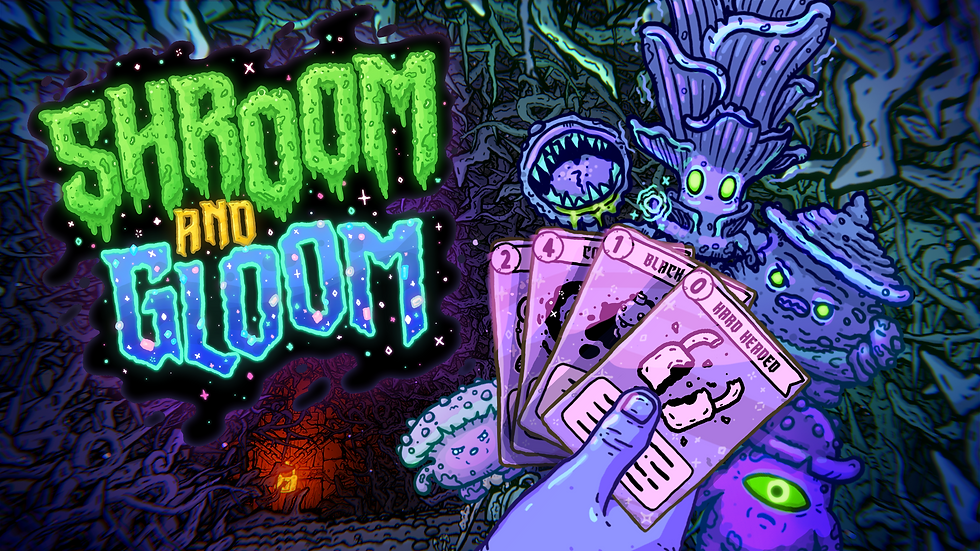
On the whole, Team Lazerbeam threads that wondrous "spooky not scary" line to perfection. As you navigate forward in first-person through claustrophobic caverns that quite literally envelop you as you push forward, you'll come upon clearings where you'll be met with some of the most stumpy, charming lil' fellas you've ever seen. Your goal? To kill, maim, and cook them to perfection, before leaving the remains behind to go rest at your camp. At camp, you'll use the light of the campfire to push back the creeps in the dark who'd otherwise see you dead.

Between these wibbly wobbly shadow-beings and the comparatively harmless you meet at camp, including a demanding frog prince and a horrifying doll embedded in the dirt, you're never left quite comfortable. Cute, creepy, and cruddy (lovingly) are the words I'd use to describe the vibes of Shroom and Gloom's world.
The gameplay loop, encounter > camp > choose a path > repeat, is simple and satisfying. It's also where we introduce the concept of Shroom and Gloom's two decks: one for use in combat and one for use at your camp, which the game calls the explore deck. Your rewards for defeating enemies and for exploring each new campsite fully will fill either deck, and the two decks can feed into each other in unique ways.
Combat cards are self-explanatory — deal damage, debuff opponents, and turn said opponents into food. There are some fun synergies with cards that offer a permanent boost, for example a max HP increase when you eat or a damage upgrade on the weapon that deals the fatal blow to enemies. These can quickly spin out of control the more you stack upgrades onto them.

As you explore, you'll unlock stations to install at your camp that give you specific boosts, like the kitchen that helps with food creation and the training dummy that’s pure combat boosting.
At camp, your deck is made up of cards that do one of a series of unique camp actions: fixing restores your installed stations for extra uses; igniting lights torches and campfires to push back against the damage-dealing darkness that builds with each turn you rest; breaking/unlocking opens chests and new paths forward.
It's all straightforward and simple logic that rewards you for experimenting. Try igniting that mushroom instead of digging it up next time. Or feeding that weirdo laying in the middle of your camp instead of breaking it.
Whether in exploration or combat, you have a limited amount of energy per turn that requires some strategizing and risk-reward thinking on your part.
With all these interactions, it can end up incredibly easy to break the game, and Team Lazerbeam knows and encourages this. By the end of my most successful run, I had multiple cards that did 100+ damage, a card that produced six consumables every time it killed, and multiple cards that permanently upgraded their damage when I ate those consumables.
Once you familiarize yourself with the game's core concepts, it becomes easy to ideate on new ways to exploit them. I'm sure this will balance out through the game's Early Access period. Already, the team has made sweeping changes with patches to the game's far harder second zone, but the power scaling is fun as hell as-is.

Shroom and Gloom is all about turning your most basic cards into death-dealing machines. Turn a basic "deal 3 damage" stab card into a one-hit killing beast through slow iteration at your camp, and slowly shed away unnecessary cards so you're almost certain to draw your best card whenever you need it. Maximize the actions you can take at camp to get your max HP up as fast as possible. Slowly chip away at these obstacles until suddenly you're unbeatable. It feels good to play, and it'll only feel better the more they tinker with the game.
If there's one detractor, I'd say that Shroom and Gloom can be a challenging game, especially in the early going as you're still learning its quirks, and especially if you aren't an innate mastermind of roguelike deckbuilding. Some of your early runs can feel pretty discouraging, especially when you find yourself stuck at a particular chokepoint.
But once the concepts click, you soar. Each class feels super unique, and the game's second zone (which once unlocked can be your starting point for runs), plays almost entirely differently from The Gloom. It's much, much harder — but again, with the team’s active patching, I'm certain that balance will be found with time.
I'm also missing the long-term meta progression of other games like it. Each class comes with a unique set of cards to unlock, but not on the scale of some of the others in the genre. At the same time, it's a bit refreshing that what you see is what you get, and you can master all that comes in the tin for the time being.
On the whole, Shroom and Gloom is one of those Early Access titles I can almost wholesale recommend as the type of investment that you'll immediately enjoy and be able to see demonstrable change in throughout its Early Access period. Team Lazerbeam is already hard at work tweaking the experience and promises to add an entire third and final zone, complete with its own classes and cards to add to the game's existing 300+ cards.
The double decks don't feel like a gimmick, the exploration and experimentation in both phases is satisfying, and Team Lazerbeam's art style sings in the first-person perspective. Shroom and Gloom is an Early Access gem that we'll be watching eagerly, and continuing to play actively, on its way to a 1.0 launch.
Shroom and Gloom will be in Early Access for 12–24 months, is set to stay at its current $14.99 price point throughout launch, and has already released consistent patches in the week-plus since launch, earning the game VGG's Seal of Early Access Approval. Check back for updates throughout its Early Access period.


Comments