

REVIEW: Forbidden Solitaire is perfect execution of an absurd idea born out of a genius partnership

When it comes to icebreakers, one of my favorite facts to share about myself is . . . I love solitaire. When it comes time for me to busy my mind and calm myself down, there's no better way for me to do it than by booting up a game of solitaire.
I've got 726 combined hours across my phone and computer in Microsoft Solitaire Collection, where I've reached far beyond level 100 across each of the game's forms of solitaire and have collected one of the rarest achievements in the game. I used to regularly play solitaire with a physical deck of cards as a child. And whenever a game features a solitaire minigame, it immediately gains my favor.
So when I say Forbidden Solitaire — a collaboration between indie solitaire makers Grey Alien Games and Home Safety Hotline's Night Signal Entertainment — was one of my most anticipated games of 2026, I mean it.
And when I say it exceeded my expectations after six hours of solitaire-in' my way through dark dungeons, I really mean it.

Just the Facts |
Developer: Grey Alien Games and Night Signal Entertainment |
Publisher: Grey Alien Games and Night Signal Entertainment |
Platform(s): PC |
Price: $15.99 |
Release Date: April 30, 2026 |
Review key provided by developer. |
Forbidden Solitaire just might be one of the smartest and most exciting indie collaborations in recent memory. Hot off the home-grown horror that was Home Safety Hotline, Night Signal Entertainment had shot up our must-watch lists as one of the most inventive indie studios out there. What they'd announce next felt like some sick and twisted prank targeting me in particular, because it was too good to be true. They were teaming up with UK-based Grey Alien Games, who I knew from the incredible Regency Solitaire series (think Jane Austen meets solitaire) to make a Fake OS indie horror solitaire project.
It'd feature mixed media and FMV cutscenes, the expertise of the analog horror stylings of Night Signal Entertainment, and a solitaire gameplay system that was honed over years of releases from Grey Alien Games, a studio that’s inarguably among the best in the solitaire field. In essence, a combination that must have seeped and oozed into reality straight out of my wildest dreams.
In Forbidden Solitaire, players inhabit Will Roberta, a nostalgic gamer who tracks down a copy of a game from his childhood at a thrift store. After booting up his PC and messaging his sister Emily about how their mom never let them play this "violent" video game back in the late ’90s, Will starts to play this silly little solitaire game that'll change his life.
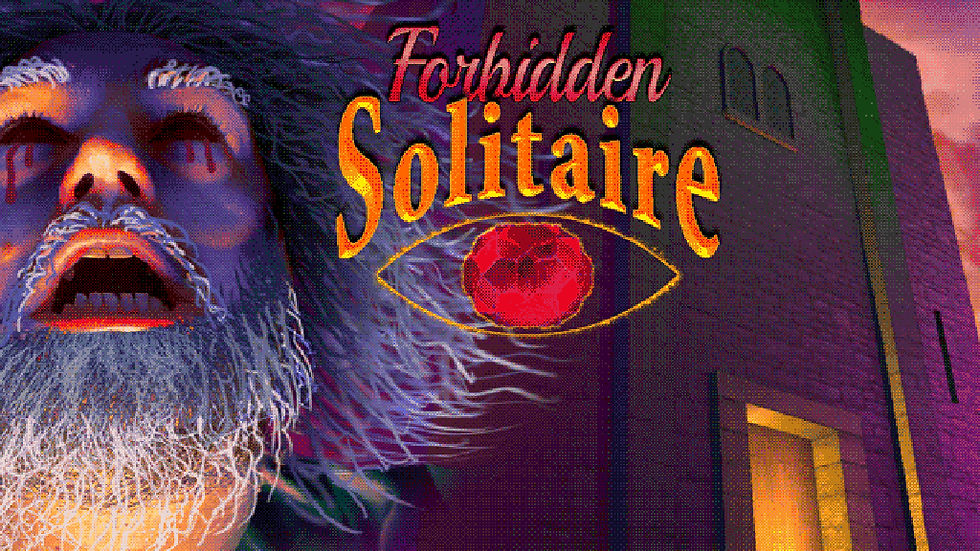
What immediately strikes me about the game is its authenticity. I can practically feel the plastic sleeve it came in strapped to some cereal box. The soundscape transports me back to the era of digital encyclopedias and 15-in-1 card and word game discs from the Hoyle series out of Sierra. And the simultaneously chunky and smooth nascent CGI graphics of the era, with all their innate uncanny horrors, bring me back into the impressionable place my mind needs to inhabit to feel just the right amount of unnerved by this game-within-a-game.
In Will’s game, a wizened adventurer wanders into a mythical place known as the Forbidden Dungeon in hopes of unlocking the secret to eternal life. While inside, he'll use magical cards to defeat his foes and slowly make his way deeper into this horrifying place, made up of dungeons themed to each playing card suit. Caverns of gems and diamonds, fleshy beasts chasing you down in the realm of hearts, and so on and so forth.
But as Will plays, his sister dispenses constant reminders of what actually happened around the game's development. Messages interrupt his session with information about game developers who wound up dead at the studio, about the legends and lore behind its alleged curse, and about the very real ways it affected the lives of the people who ended up playing it. Will's silence in response grows increasingly concerning, seemingly drawn into the game again and again, despite the severity of the warnings.
Despite the voices that literally emerge from the game like ghosts in the machine, showcasing a troubled game developer with a dangerous past and the laissez-faire author turned game studio head putting pressure on his team to succeed, Will pushes on.

It's an effective narrative, amplified by the earnestly cheesy FMV work that Night Signal Entertainment deploys once again here, complete with a true crime TV show hosted with the right amount of charming smarminess by actor Archelaus B. Crisanto and a perfectly ’90s live action commercial for the game starring Night Signal's founder, Nick Lives. At the heart of the story, though, are the dueling developers at Heartblade Interactive: the put-upon Shannon, portrayed by Jackson Maxwell, and the in-over-his-head sleaze of a studio head Lucas B. Heart, portrayed by Xalavier Nelson Jr.
As Shannon's work is continually taken advantage of by an overly ambitious Lucas, their story depicts a too-familiar tale of game development woe and becomes the most enticing part of Forbidden Solitaire's narrative. Both performers are pitch-perfect, with Maxwell's exasperation dripping out of the screen and Nelson's painful promises managing to come across as charming right until the narrative takes a darker turn. And the way this horror ends up layered, both in the spooky-not-scary horror of the game itself and the drama surrounding its development, makes for a genuinely chilling story about meddling with forces you don't understand and facing the dire consequences.
Between the news reports, the fake magazine ads, and the "so real I almost forgot it was for a 2026 indie game" aesthetics of Forbidden Solitaire, it manages to sell one of the most authentic retro experiences I've played in recent indie horror history.
And yeah, the solitaire of it all has a lot to do with that.

For the solitaire novices amongst us, Grey Alien Games employs what is known as the TriPeaks variant of solitaire. In TriPeaks, cards are assembled on the board in random shapes — usually three peaks of descending triangles of cards — and your goal is to wipe out all of the cards on the board. To do so, you'll use ascending or descending rank to remove the cards from play, drawing from a stock of cards when you are unable to remove any. You can only take from the cards that are on the top layer and not covered by any others, so it's just as much about clearing out trouble cards as it is about removing as many as possible each turn.
If that's confusing at all, I swear it makes infinitely more sense in play. It's all about just going up or down the scale and is one of the most simple and accessible forms of solitaire to play. What Grey Alien and Night Signal do here to consistently layer complexity on top of TriPeaks is what makes this game so exciting.
It's simple, addictive, consistently rejuvenated by new ideas.
In Forbidden Solitaire, there are two types of encounters you'll face: puzzle and combat. Puzzles show up whenever our hero faces some sort of obstacle, such as a locked door or being trapped in a magical hedge, and your main goal is simply to get rid of all of the cards on the board. To help you along the way, Forbidden Solitaire offers a few enhancements to shake up the simple format.
There are the Joker cards that offer simple boosts, like a wild card that allows you to continue your card combo with any card rank, or the ability to eliminate two cards from the table at random. And as you achieve longer combos in the cards, you'll earn money which you can spend at the shop to give yourself permanent boosts in the form of gems. Some unlock combos that earn you money earlier and build up mana faster, which you can unleash in a mana storm that erases cards; there are gems that flip over more cards at the start of a hand so you can begin to plan ahead when making your combos; and even gems that amplify the damage you do or revive you once after failing a combat scenario.
Oh yeah. Combat.
In combat, you'll fend off an opponent by slowly building up damage with longer and longer combos and using shield cards scattered on the tableau to withstand their attacks every so often. Each hand you play is a turn, and each turn your opponent will either do damage or poison the well of cards with damage-dealing worms or strength-sapping cards that make your attacks weaker. TriPeaks starts as a simple "clear the board" game, but with all these wrinkles, your priority shifts with each turn. And the teams behind Forbidden Solitaire never fail to come up with a new idea to further complicate things throughout the game's 5-6 hour runtime, making sure the format never grows stale.
It's simple, addictive, consistently rejuvenated by new ideas, and completely fitting for the narrative. This is exactly the kind of game that was being made in the ’90s, either for your browser or sold in chunky boxes at the dollar store — games with simple traditional tabletop concepts gussied up for the new digital era. It works so well, and the tension of the layered horror translates beautifully to the inherent tension of a game of solitaire, where you see your stock of cards dwindle with each click and know the end is nigh.
I don't know if this comes from the 700+ hours of solitaire experience or not, but I did find the challenges fairly easy all throughout. Only the game's final hour really managed to trip me up. But it was always engaging and always fun.

Forbidden Solitaire is a near-perfect game to me. It's quick, it knows what it is and stays true to itself from end to end, and it's created with such heart that you can't help but smile all the way through.
Dream games are few and far between in this industry, and for me, Forbidden Solitaire is a dream game. Grey Alien Games and Night Signal Entertainment found each other at just the right time to make something no one else is making, make it right, and pour all they have into it.
Video Games Are Good and Forbidden Solitaire is . . . GREAT. (9.5/10)
+ a genuinely genius collaboration, '90s retro aesthetics are on point, a solitaire experience that never grows stale
- the solitaire can be a little easy, spooky-not-scary may not be everyone's horror cup of tea, no endless mode :(
Thanks for reading this Video Games Are Good review. Learn more about our review rubric — and if you'd like to discuss reviews and get early views at upcoming articles, join our Discord. We're proud to continue bringing human voices and thoughts to the video game journalism and media landscape. Thank you for supporting our coverage!


Comments