

A Third Life Crisis or . . .

Three reviews of three special games or . . .
What VGG has been up to for the last few months. Take a pick. It's any of those things. It's all of those things. It's an experiment. It's a way forward. It's a summary of a person's crisis. It's video games. It's not.
It's our return after a few months of restless sleep.
Video Games Are Good.

In the middle of one of my first major life crises, I remember sitting in an office, wearing a sombrero, writing mindless articles whose only real prompt had been given to me by my boss just hours before: "Quantity, not quality. That's what matters here. And I think you're hung up on the second part when we need the first."
I had just exited my longest and at the time most meaningful relationship, my parents were in turmoil, and I was sitting in an office fitting keywords as often as I possibly could into mindless slop as an Editorial SEO Intern for a company that would rebrand fifteen different times and that considered a rock-paper-scissors tournament the kind of quirky intrigue that kept its employees happy. They don't exist anymore, but I wonder if whoever took their offices still listen to Howard Stern during the workday.
I should have appreciated the gig while I had it. There's no way a human would ever be considered for that kind of writing in today's world, as mindless and painful as it is. At least the keyword insertion work had a bright-eyed and bushy-tailed kid writing it instead of Grok.
I wasn't happy. But I didn't know what I was. I was the sounding board for many of my friends, I understood the terrors that plagued their minds, but I didn't really know what depression and anxiety were. A lot of us didn't then. A lot of us still don't.
It was in a video game that I finally realized I was depressed. Zoë Quinn's Depression Quest was probably the first game that I saw myself reflected in, an interactive fiction game made in Twine that detailed a person's struggles with depression and how that beast could take over their lives. How without proper treatment and care, depression could lock them out of being able to do certain things and how that vicious cycle could spiral out of control. It was in this game that I saw myself fully for the first time. But how could that be? I was the stable friend, not the depressed one.
But there I was. Staring up at the world from the bottom of the pit for the first time, a place I'd become deeply acquainted with in the years since. And a video game helped me start to climb out of it.
Fast forward thirteen years, two therapists, and four on-and-off stints with Wellbutrin, and I find myself staring up from the pit again.
Having run Video Games Are Good now for almost as long as I've held any other job in my life, I reach the point of questioning myself and wondering why. I've always struggled with self-worth and imposter syndrome, to the point that my self-hate spirals almost led to me closing VGG for good several times last year. Who cared to read my thoughts on all this? Where is this all leading? What's the point?
With all the leading voices that inspire me every day losing their paid gigs with gaming outlets and falling into the same attention-fighting space with the rest of us, I struggled to imagine my voice could maintain some level of intrigue alongside them. I struggled to keep up with an industry that is pumping out video games faster than I've ever seen, and while a lot of them were unremarkable slop churned out by GenAI, many of them were extraordinary and needed to be talked about. But every deadline missed, every game launch we wanted to cover but couldn’t, just buried me even further.
I was irrelevant. I would always be irrelevant. And all I was good at was silly video games writing.
I was lower than I'd ever been in the pit. I needed purpose. But just like then, it was games that helped me start to climb out. Sometimes the world works in funny ways, though, and the game the world offered me this time? A bit on the nose.
CAIRN

Cairn is a mountain climbing simulation that, just a few months into the year, I'm confident in saying is one of the best games of 2026.
The latest from the French team behind Furi and Haven, The Game Bakers, Cairn tells the story of Aava: a perfectionist whose passion is conquering and climbing mountains. She's climbed every peak, she's done all she could possibly do, and she's off to attempt a challenge that has never been completed before: Mount Kami, a gigantic peak that has claimed the lives of naive and experienced climbers both over the decades of past attempts.
Equipped with her climb-bot, the desire to reach the pinnacle of pinnacle-reaching, and the nagging of her agent looking to monetize and commodify her talents, Aava embarks on this perilous journey. As she climbs, as I write, she's haunted by the worries and concerns of her loved ones and those she meets on the wall. They don't understand. They would never understand. They don't understand. They won't ever understand. This is all she has, and if she can't focus, if she can't do this, what does she have? If I can't write, if I can't keep this up? What do I have?
As Aava climbs, she picks through the literal rubble of a society that once lived alongside Kami's crags. And as she does, she finds parts of her she never knew she was missing. It's a testament to the human spirit, to connection across generations, and to the pains that perfectionism provides.
I found myself relating a bit too much to some of Aava's spiniest points. The same things I was chiding this perfectionist for were things I could directly connect to my own life. It was simultaneously eye-opening and self-awareness shield-prompting. It was a story full of deep introspection and I was still scared of losing myself to that kind of thinking. But Cairn helped open the door to some of the kinds of thinking I thought I needed to be doing.
The Game Bakers were set up well for the climb with this compelling narrative start and managed to supply Cairn's adventure with gameplay that matches its peak-chasing dreams.
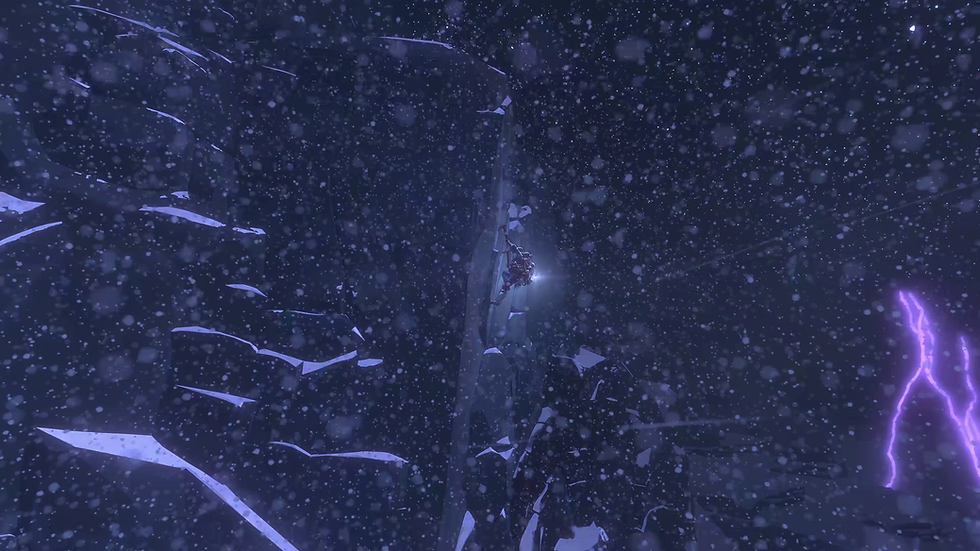
Having spent some time in the Cairn community since launch, Alpinists and gamers alike have praised The Game Bakers for their ability to recreate the physics and mental processing needed to experience what climbing is really like. In Cairn, you control Aava's individual limbs one by one to find footholds, grabs, and cracks to pull yourself up the mountain. There's an almost Foddian quality to the climbing experience, one that makes it silly and janky at times in the ways that Bennett Foddy's Baby Steps, QWOP, and GIRP are. But instead of leaning on the comedy, it chooses comedy's best friend and embraces tension.
As you climb, Aava's limbs quiver and shake if your balance is off, if your holds are imperfect. An unseen stamina depletes and, if you aren't hooked into the wall properly, death might await as Aava comes crashing down. Even if you are, depending on how far you've climbed since placing your hook, hard-earned progress can be wiped away just as quickly. This constant tension guides your way up the mountain as you decide when to rest, when to spike a piton to serve as a bit of a checkpoint, and what risks are worth taking.
As I climbed, I peeked in at the community building around the game. Of real climbers who were offering tips about balance, climbing with your legs, and taking your time. It was amazing to see a game that could so easily have real-life advice applied to its gameplay systems and stood out to me as a testament to the simulation systems the team had crafted.
Kami is a perfectly paced beast, with its early climbs allowing for some experimentation and letting you learn how to make mistakes without death being a certainty, so that by the end you treat its most treacherous climbs with more respect. Along the journey, there are fun narrative breaks as you learn about the tribes that inhabited the walls of Kami and meet those who hang onto their hopes and dreams, as misguided and dangerous as they might be. And there's a survival system in place too where Aava must keep herself hydrated, fed, and warm through foods harvested from the mountain and found in the packs of climbers who've died on the climb before her.

Cairn's simulation systems can be a bit janky at times, the survival aspects can be inconsistent, and the difficulty varies wildly from climb to climb, but it remains one of the best experiences I've had in gaming in the last few years. My hands sweat with each climb, my frustration built alongside Aava as we screamed against a poorly timed drop wiping away the half-hour of climbing we'd just endured, and I felt accomplished when I reached my ultimate goal. The way people talk about beating Malenia in Elden Ring is how I'll talk about my journey up Kami. It's masterful. It's unlike anything else you've played (even with the outburst of climbing games over the last few years). And it begs to be played.
The mountain is calling.

Cairn lifted my spirits. It begged to be written about. And still I found myself standing at the base of this particular mountain, shaking before I'd even got on the wall. Unable to move. I found too much to relate to with the abrasive and isolating Aava and found myself blinking away tears by the time her story was up. But no closer to figuring out what was going on with me. No closer to making my journey any easier.
I don't sleep well. I have almost never slept well. I toss and turn. I feel as though I'm never actually resting. And then I wake up and it's the middle of the day and I feel useless. So I try to achieve something, anything, with what remains of the day, usually ending up staying up late once more. And the cycle continues.
One of my solutions in the new year was to make use of the tossing and turning hours and instead fill them with something else. A new thing to try to find purpose in. I started reading. I went to bed at the same time my partner did, a normal sleeping hour, and popped open a book. Then another. And another. And another. At time of publication, I've read 39 books this year after spending years (read: genuinely more than a decade probably) away from reading.
It was early in my reading journey that I stumbled upon my next game in the ongoing pilgrimage to find answers, one that again landed in front of me in just the right time and with just the right story to tell. This is the story about how I fell in love with . . .
PERFECT TIDES: STATION TO STATION

Perfect Tides: Station to Station is the second title telling Mara Whitefish's life story, a point and click adventure that takes us out of Mara's youth and into her college years, away from her island home and into the big city. She's in school to become a writer, and thus reading and writing are at the heart of her journey. Mara absorbs inspiration from the world around her as she deals with classes, relationships, new friends, and the hustle and bustle of her new life.
The story is told through seasons, as Mara's time at college rollercoasters through key moments in a year full of upheaval. You'll attend classes, see shows in cramped venues, smoke weed at dorm parties, crash on a friend's couch, deal with a sudden breakup, and suddenly it's my life. I'm in college, I'm freshly broken up with after the longest relationship of my life. I stop going to classes, I'm so depressed. I play a game called Depression Quest and get a job. My uncle ends up in the hospital and unable to live on his own. My family takes him in. This basically ends my parents' relationship and neither is really equipped for what comes next. So I have to be. I'm no longer in college. I'm playing games. I'm writing an admired author in the middle of the night with my life in shambles around me. His response changes my life. I'm trying to survive. Mara's trying to survive.
Perfect Tides: Station to Station ends up being just as much a glimpse into a time and a place as our 2025 Game of the Year winner Consume Me, as it transports players into the early 2000s and into an analog for New York City. Pop culture references abound, as do the tensions of that era and the simplicity of the early internet. AIM chat rooms, dreams about the latest Matrix and Lord of the Rings movies buoy people, and somehow it's the conversations you have with fellow intellectuals that make you feel like you matter in the moment.
It's grounded with familiar writing, with conversations we've all had that don't feel like bits of some grand story. It's real. It's authentic. And it's funny.
Founder and lead developer of Three Bees, cartoonist, and animator Meredith Gran's semi-autobiographical work reaches out and taps on an almost exact replication of the trajectory of my own life and it keeps me up at night.

Perfect Tides: Station to Station manages a ton of interesting gameplay systems to make its narrative point and click adventure feel unique. Everything Mara experiences adds to her inspiration base, a mental skill tree that levels up as you partake in some part of life over the other. All of Mara's writing throughout the game pulls from these "skills," and the quality of each piece of writing depends on which subjects and ideas you choose to combine and how much you've invested in Mara’s firsthand experiences with these things.
Choose to spend the day smoking weed with a friend instead of going out for a night on the town? See your "drugs" knowledge base go up and your "city" knowledge base stagnate. Then when it comes time to write something for a reading at a local bookshop, you'll pull from that drugs skill and combine it with your already growing movie knowledge to craft something effective. You imagine Mara writing about the effects of the war on drugs in ’90s films and feel satisfied with your choices.
It's a great representation of how one's life experiences influence everything they do and a genius way to seed in some traditional game elements in what is otherwise a narrative-heavy experience. It's basically an RPG.

I don't know if I believe in fate, but right when my life started to turn around after the no-good-very-bad patch that led me to drop out of school and lose my drive, I stumbled on an online comic that reached out and tapped on my anxieties then. It was called Octopus Pie. And it was written and illustrated by Meredith Gran. I've taken the train through the seasons of my life and ended up stepping out in search of some guidance once again, and it's Meredith there with another deeply relatable and deeply resonant story of finding the self when the world decides you're suddenly an adult.
Perfect Tides: Station to Station is chock-full of brilliant writing, and it pushed me back onto my feet just when I needed it. It was exactly the kind of honest and grounding experience I needed, evoking some of my more stubborn and painful years — tied with some beautiful moments of magical reality that reminded me of the power of connection, and how that’s the only way we make it through this life.

Cairn gave me the drive. Perfect Tides: Station to Station reminded me why I do what I do. And I nearly felt ready to return. But then came the final beast. Having to face our community, having to face the people who'd read anything I wrote about my months-long crisis, having to face my partner Julie who runs the site with me. The mere thought of it stirred chaos in my gut and mind.
COVID ruined me. Before it, I used to be an affable person, someone who more related to the concept of being an ambivert than to the introversion I had previously assigned myself as I grew up. I worked at a community theatre and felt myself slowly changed by the hundreds of people I interacted with on a weekly basis. I enjoyed the company of others, enjoyed hosting and comforting a room full of people. Then the big old unprecedented times hit and I was forced inside for years.
I left my job out of necessity. I started VGG. I stopped seeing my friends. I lost family members to the disease. I forgot the feeling of crowds. Where strangers once represented potential friends, now they were sources of fear; potential spreaders of the virus, potential angry reactions to my masked face, potential disappointing at best or disastrous at worst attempts at connection in an era of isolation. I stayed inside and it was easy. Then the years went on and folks tried to return to normal in a not-normal world. But I couldn't. That fear gripped me tighter and even mandatory outings like grocery runs started to feel like a nightmare.
I effectively became a hermit. Anxiety controlled me and I let it make my decisions more often than not. I considered ending VGG several times last year at the beckoning of my anxiety, because it told me that I brought nothing to the table. That my voice was unnecessary. I stopped writing for months. But games, as always, pulled me back. And one last time, a mirror was pulled up for me. An email from another Nathan presenting his game:
HERMIT AND PIG

Hermit and Pig is the debut project of childhood friends Mason Dickerson and Nathan Kennedy (Heavy Lunch Studio), a love letter to the likes of Earthbound and the games it spawned in its wake. It's an RPG full of contextual minigames, quirky characters, and a hero who can sometimes take more damage from talking to a stranger than he does in actual combat.
Hermit and Pig are your eponymous heroes, a pair of friends who live in a hut in the woods, hiding from the loud world together to instead spend their time foraging for mushrooms and lazing about. When a little girl stumbles into their humble paradise with panicked concerns about some evil corporation and an impending food shortage, their sleepy lives are forever upended. She's come looking for their help. She knows the duo are experts at foraging for their own food and hopes their gathering skills are enough to save her town.
There are talks of a mystical mushroom that could feed thousands, and the framework of an adventure is set. Hermit and Pig's adventure starts and ends with whimsy, a journey that’s silly but secretly holds a tale full of radical hope. Last year, Superman told us that maybe looking for the best in others, maybe choosing kindness and happiness over everything, was the harder choice in a world full of darkness. "The real punk rock." Hermit and Pig carries that same banner and reminds us that we don't have to do any of it alone.
Because, silly or not, it also doesn't hide from jabbing at actual fascism. (The evil corporation is often acronymed down to DT, take that as you will, and an entire segment of the game parodies the spineless people who join up with forces like ICE). It's quirky, but it's radical in its depictions of what our world can look like — reckless consumption of mushrooms and all. In a world undercut by capitalist corruption and depraved indifference, it's hopeful above all else. And that's what I . . . what we need most these days.

Hermit and Pig is just effortless. Not in the difficulty sense — it's actually trickier than you'd expect to get great at it — but in how easy it is to slip into. With the ease of play, its strong use of the turn-based RPG formula, and its breezy 8-hour runtime, Hermit and Pig is one of the easiest RPGs to recommend and enjoy.
Combat takes place through a series of minigames. Timing meters dictate dodging and blocking, and fighting game-like directional button combos are how you deal damage, with certain combos tied to certain damage types. Up-down-up equates to Hermit stomping down on his enemies, left-left right-emulates the swinging hook of a Hermit punch, and so on.
You've got to essentially memorize these as you go along, and they get more complicated, making for a tricky little combat mechanic. And it's up to you to visually read each enemy's stance to decipher what attack would do best against them. Someone leaving a foot out to be stomped? Stomp. Got a flying enemy that'd be hard to smack? Use the slingshot.
There are a ton of accessibility settings and gameplay-modifying trinkets that help you change how involved these systems are, but nearly everything is tied to some kind of fun contextual minigame.
What's even more fun is the fact that every single conversation you have as Hermit is framed within the combat screen. Even the most innocent-looking NPC takes you to the combat screen where players choose one of three responses to properly navigate these conversations. Say the wrong thing and you and your conversation partner will cringe, leading to Hermit taking physical damage. And in the most unexpected of places, I felt a weird bit of representation. So many conversations I enter into nowadays feel just like this, like small battles where careful consideration of my words will dictate how things will end up. Where one awkward statement can send my body reeling with a physical ailment, both in the moment and hours later in those long stretches where sleep eludes me.
It's a simple thing to be seen, but it made me smile nonetheless.
There are simple puzzles, short chapters, and sneakily clever boss fights to punctuate each chunk of the game. Hermit and Pig never loses its charm from end to end.

Radical optimism has been an anchor of what we do at VGG for years now, and to see that echoed in a game as fun and joyful as Hermit and Pig is always a good sign that we're on the right side with what we're doing here. A sign that figuring out a way forward with our community is more worth it than to hide away in the woods and buckle under the darkness of our world alone.
Hermit and Pig is a bright light in an otherwise darkening industry and an easy recommendation for RPG fans of all kinds, especially Earthbound and Undertale lovers looking for another adventure to smile with.

I think I built up what this story would be in my head. That it would be this grand return to writing for our little site and it'd make everything make sense. These three games did help break me out of my funk. Everything I wrote in here is true. But I still don't have all the answers and those voices telling me I don’t matter are still around.
It's impossible for a site of our size to keep up with the release schedule of games these days, it's impossible to not feel like we're being left behind when we don't, it's impossible to feel like any of this matters in the wake of everything happening in our world. But when there are games like these to talk about, it's worth sticking with it.
We might be a little slower this year, a little more casual, but Video Games Are Good keeps going. I might slide even more of myself into these articles, if this one wasn't too much. But things will inevitably be different for us in 2026. If this piece wasn't already proof of that.
I hope this story has opened the door into my messy brain a bit and showcased the power of what video games can be and what they can do. Video games keep saving my life every day and that's worth writing about.
Video Games Are Good and Cairn is . . . GREAT. (9.5/10)
and Perfect Tides: Station to Station is . . . GREAT. (9/10)
and Hermit and Pig is . . . GREAT. (8/10)
If you want to support what we're doing, follow us on Bluesky, support us on Patreon, and comment below about how your 2026 has gone so far. Which of these three games compels you most?


Nate, let me tell you a story, as I was telling it to another depressed friend of mine today.
I moved to this apartment some 4 years ago, after a catastrophic breakup ("roommate divorce" is more like it). It's small, dilapidated, run by negligent landlords, and soon all my ceiling bulbs burnt out. I just couldn't bother to fix them. The table lamp is good enough, right. I know I'm mentally ill. My executive functioning is nil. "Just do a small thing every day", said my psychiatrist, so why can't I even change my lightbulbs? It's like that for everything. Some 6 months ago, a singer I really like, Bea Duarte, put out a new song "Casa". Would be…
Loved this article!
Once a week or so, a thought would pop into my head "I wonder when the next VGG will come out" but knowing myself how external pressures can be, I often default to simply being patient, not pushing, not asking.
As an individual who manages both a personal life and a online presence, your own presence (and Julie's) has inspired me to reach for greater levels of compassion and forgiveness, both of myself and others.
You also consistently fill me with curiosity, and excitement for games that are just outside my periphery. The world is so vast and large, and there's a beauty in that. But it's also kind of terrifying, thinking that I can't see it all, I can't…
I want you to know what the voice that you say "adds nothing new" has 100% consistently inspired me. I'm here going through the same motions as you, and just barely managing to step forward - but you and the things you do consistently help me move forward. I know I can't make anxiety go away, but here's one for your "when you're sad read this" folder -- and if you don't have one yet, make it and fill it with screenshots and quotes that prove anxiety wrong every time - YOU. INSPIRE. ME. I legit wasn't kidding when I said I was looking forward/waiting for when the next VGG article would come up, cause you write so wonderfully well.…